Miller–Urey experiment

The experiment
After Miller's death in 2007, scientists examining sealed vials preserved from the original experiments were able to show that there were actually well over 20 different amino acids produced in Miller's original experiments. That is considerably more than what Miller originally reported, and more than the 20 that naturally occur in life.[7] More-recent evidence suggests that Earth's original atmosphere might have had a different composition from the gas used in the Miller experiment. But prebiotic experiments continue to produce racemic mixtures of simple to complex compounds under varying conditions.[8]
Experiment
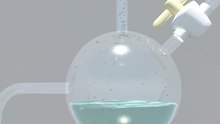
Descriptive video of the experiment
After a day, the solution collected at the trap had turned pink in colour.[9] At the end of one week of continuous operation, the boiling flask was removed, and mercuric chloride was added to prevent microbial contamination. The reaction was stopped by adding barium hydroxide and sulfuric acid, and evaporated to remove impurities. Using paper chromatography, Miller identified five amino acids present in the solution: glycine, α-alanine and β-alanine were positively identified, while aspartic acid and α-aminobutyric acid (AABA) were less certain, due to the spots being faint.[4]
In a 1996 interview, Stanley Miller recollected his lifelong experiments following his original work and stated: "Just turning on the spark in a basic pre-biotic experiment will yield 11 out of 20 amino acids."[10]
As observed in all subsequent experiments, both left-handed (L) and right-handed (D) optical isomers were created in a racemic mixture. In biological systems, almost all of the compounds are non-racemic, or homochiral.
The original experiment remains today under the care of Miller and Urey's former student Jeffrey Bada, a professor at the UCSD, Scripps Institution of Oceanography.[11] The apparatus used to conduct the experiment is on display at the Denver Museum of Nature and Science.[12]
Chemistry of experiment
One-step reactions among the mixture components can produce hydrogen cyanide (HCN), formaldehyde (CH2O),[13][14] and other active intermediate compounds (acetylene, cyanoacetylene, etc.):[citation needed]- CO2 → CO + [O] (atomic oxygen)
- CH4 + 2[O] → CH2O + H2O
- CO + NH3 → HCN + H2O
- CH4 + NH3 → HCN + 3H2 (BMA process)
- CH2O + HCN + NH3 → NH2-CH2-CN + H2O
- NH2-CH2-CN + 2H2O → NH3 + NH2-CH2-COOH (glycine)
The experiments showed that simple organic compounds of building blocks of proteins and other macromolecules can be formed from gases with the addition of energy.


No comments:
Post a Comment